1793856401888/image_0_b7666eb3-fb34-44fa-857f-8ec8d1441712.jpeg

Class D Security License Training in Orlando

You can pursue a Class D security license in Orlando while working full time only if you can attend the required live training hours. Florida’s course requires 40 hours and can’t be completed through self-paced video modules, so plan around the class schedule before enrolling. Orlando in-person training is offered as a four-day program, Monday through Thursday, from 8 a.m. to 6 p.m.

Balancing work with training can be challenging, especially when classes run during regular work hours. Knowing the format and schedule upfront helps you decide whether an online or in-person course fits your commitments and what arrangements you may need to make.

This guide explains who qualifies for a Florida Class D license, how to apply and complete fingerprinting, and how to prepare for the exam. It also covers online training and Orlando-area class options, helping you plan the steps from required coursework to your application.

Key Takeaways

  • Review the eligibility criteria before beginning your Florida license application.
  • Understand how training documents, fingerprints, and application submission fit into the licensing process.
  • Prepare for the course exam with a focused study plan and a clear understanding of the passing requirement.
  • Explore Orlando-area class formats and schedules to find an option that works with your commitments.
  • Learn how Optimal Security’s training can support your next steps toward a security license.

Can You Take the Florida Class D Course Online?

Yes, Florida Class D training can be taken online, but it must involve live instruction, not self-paced video modules. The course covers 40 hours, and an online schedule runs Monday through Friday from 8 a.m. to 5:30 p.m. Class D is for unarmed security work; Class G is the armed security license and requires separate firearms training.

A five-day weekday schedule can be difficult to fit around a full-time job. Since instruction takes place during daytime hours, online training doesn’t necessarily offer flexible, after-hours study. Before choosing a course, compare its scheduled hours with your work and travel commitments. If you can’t attend a live session, that course format may not fit your calendar.

Online learning changes where you attend class, not the need to participate in instruction. A live instructor leads the training, while the scheduled sessions give students a set period for completing the curriculum. This differs from watching recorded modules at any time. Review the Florida Class D training curriculum to understand the subjects covered and plan your study time around the course.

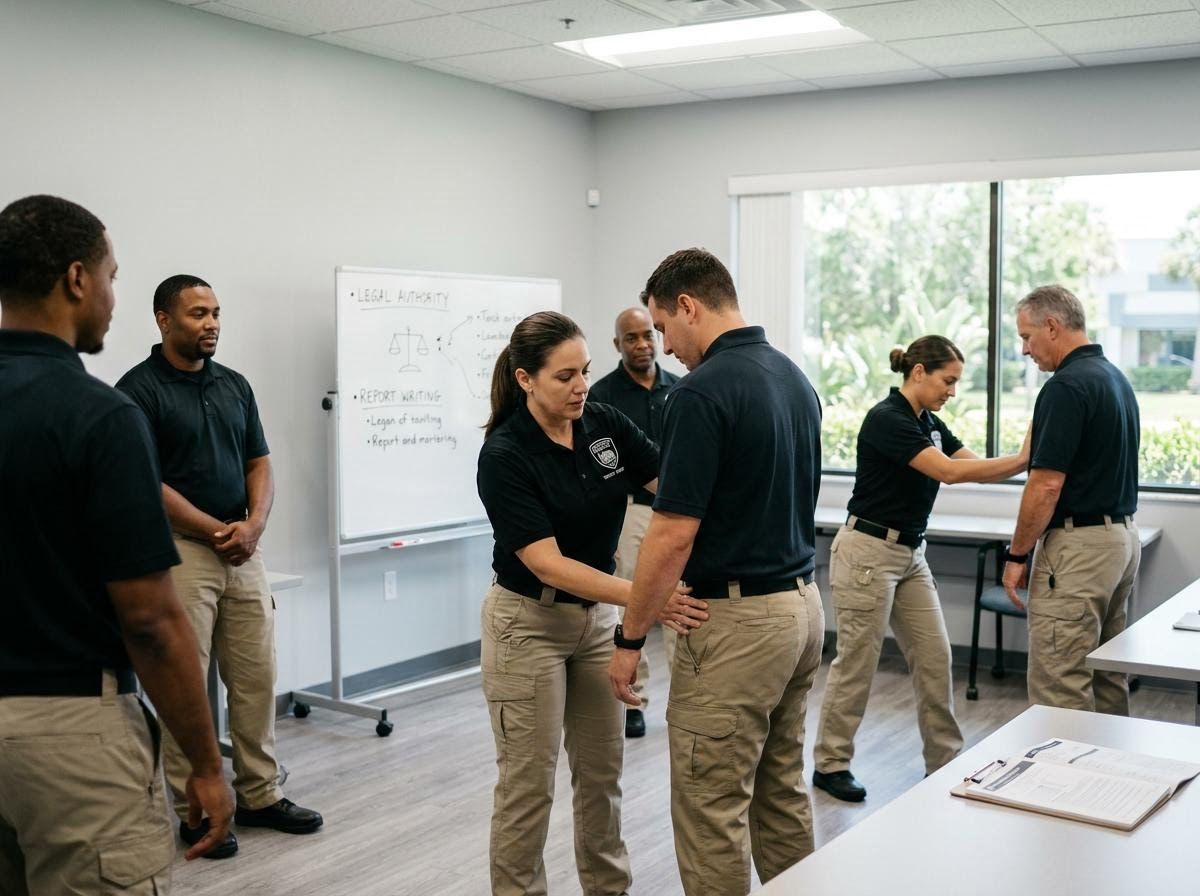
Orlando’s listed training location is 6925 Lake Ellenor Dr, Building 1, Suite 102, Orlando, FL 32809. In-person Class D training there is offered Monday through Thursday from 8 a.m. to 6 p.m., in a four-day program. That schedule provides a local classroom option, while live online classes may suit people who can attend remotely during the weekday hours.

For residents of Clermont or Fort Lauderdale, location matters as much as format. The listed Orlando address gives Central Florida students a specific place to plan around; nearby city names alone don’t mean a course is held in each location. Teaching format and schedule depend on the particular class. Check the course location before arranging travel.

Class D and Class G serve different roles. Class D is for unarmed security officer work and requires the professional training course; Class G is for armed security work and requires firearms training. The Class G course is 28 hours and is offered as a three-day program, including firearms instruction. A Class D course alone doesn’t provide the training needed for armed work.

Choose a course based on your intended role: unarmed security work calls for Class D, while armed work requires Class G firearms training. Then compare the live class schedule with your workweek and choose a training location or online format you can attend. A practical fit is essential to completing the required instruction.

Florida Class D security license admission requirements

Eligibility depends on age, work authorization, training, and criminal history. Consider these requirements separately from the application steps so you can prepare the right documents.

Eligibility and License Requirements

Applicants must be at least 18 and be U.S. citizens, legal resident aliens, or hold work authorization granted by the Department of Homeland Security, U.S. Citizenship and Immigration Services. According to The Florida Legislature, Florida Class D applicants must complete at least 40 hours of professional training, while Class G applicants must satisfy the specified firearms training.

The listed criteria also address criminal history: applicants must have had no criminal charges within the past 3 years. A felony conviction can disqualify an applicant for 10 years after completing the sentence and any supervision. Review how your circumstances fit these requirements before choosing the unarmed security course.

Application Process and Timing

After training, submit your license application to the Florida Department of Agriculture and Consumer Services, Division of Licensing. You can apply in person by scheduling an appointment at a regional office, or mail your application to the Division of Licensing in Tallahassee.

The licensing process is estimated at 2-4 weeks from starting training to holding the license. Applicants with clean records often receive approval within 5-10 business days after submitting their materials.

Training documentation is a key application item. Applicants who completed a 40-hour course through a licensed Class DS school or training facility on or after July 19, 2023, should submit a printed copy of their training certificate. Qualifying military training may satisfy the training requirement under Rule 5N-1.119(4) of the Florida Administrative Code. Certain current law enforcement, correctional, and correctional probation officers can also meet it through an agency-issued valid ID card. A certificate of completion from a qualifying Florida Criminal Justice Standards and Training Commission program may also satisfy the requirement.

Application costs should be distinguished carefully. Florida does not require a Class D application fee, according to The Florida Legislature. The listed Class D license fee is $45.00; fingerprint processing is $42.00, and fingerprint retention is $10.75. The approximate total for the license application and fingerprint processing is $97.75.

What are the application and renewal fees? The listed application and fingerprint-processing total is approximately $97.75; the renewal fee amount isn’t included in that figure. A renewal or replacement is handled through the Division of Licensing, so use the relevant transaction instructions rather than treating the initial application total as a renewal amount.

To check your application status, follow up with the Florida Department of Agriculture and Consumer Services, Division of Licensing, which receives Class D applications. Have your identifying application details ready so the inquiry can be matched to your submission.

To renew or replace a Class D license, follow the Division of Licensing’s instructions for the relevant request. Keep your license information handy and distinguish a replacement request from a renewal, since these are separate licensing actions.

Training and employment are separate steps. Completing security training supports your license application but doesn’t itself secure a job. In Central Florida, treat a job search as a separate process after meeting licensing requirements; employers make their own hiring decisions.

Application steps and fingerprinting

After completing security license training, submit your Class D application to the Florida Department of Agriculture and Consumer Services, Division of Licensing. Your application route determines what to do next: schedule an in-person appointment at a regional office or mail your materials.

  1. Complete the training program. Finish the required course through a licensed school, then gather the training documentation needed for your application. A qualifying certificate records completion and supports the licensing process.
  2. Choose how to apply. For an in-person application, schedule an appointment online at a regional office. You don’t need to complete an application form before that appointment.
  3. Prepare fingerprints. Fingerprint processing and retention are listed as separate parts of the Class D application process. Include the applicable fingerprint processing requirements with your submission.
  4. Submit the application. Mail Class D applications to the Division of Licensing, P.O. Box 5767, Tallahassee, FL 32314-5767, or apply in person as scheduled.

Fingerprint processing is not the same as the license application itself. The listed processing fee is $42.00, and the fingerprint retention fee is $10.75. Keep these items distinct as you prepare your application, since both relate to fingerprints rather than the Class D course. The application and fingerprint materials go to the state licensing process, not to a prospective employer.

For a mailed application, use the Division’s stated mailing address and organize your materials before sending them. Preparing a complete packet helps keep the required components together. For an in-person appointment, schedule first, then bring your application materials to the regional office. This route does not require completing an application form beforehand.

The Florida Department of Agriculture and Consumer Services, Division of Licensing, handles security license applications and receives mailed submissions at its Tallahassee address. Keep a copy of the information you submit and note when you applied. These details can help you refer to the right application if you follow up on its progress.

Fingerprinting connects your identity to the licensing review. Treat it as a required application component, not a step completed by enrolling in a training program. Course completion and fingerprint processing serve different purposes: training documents show that you completed the required instruction, while fingerprint processing supports the state’s application review.

For someone pursuing an officer career, the practical sequence is straightforward: complete the approved training, choose an application route, prepare fingerprint materials, and submit everything to the Division of Licensing. The order matters because the application depends on completed training and the required materials. Keep your course documentation and application records together as you work through each step.

Class D exam preparation

Build your study plan around the Florida Class D course’s final exam and its stated passing standard. The Florida Class D security officer exam has 170 questions, and students must score at least 75% to pass the course final. The course includes 2 hours for testing, so use class time carefully and review consistently before exam day.

Start by organizing notes from each training session. Group related material under clear labels, then write a short summary in your own words. This makes course concepts easier to review without rereading every page. After a lesson, for example, record the main ideas and list any terms you need to revisit.

Use a regular review routine instead of waiting until the final class. Divide your notes into manageable sections and revisit them throughout the training schedule. After each review, close your notes and explain the key points aloud. If you can’t explain a concept clearly, mark it for another review before the exam.

  • Review in short blocks. Choose one subject area from your course notes and focus on it before moving to another.
  • Practice recall. Turn headings into prompts, then answer them without looking at the page.
  • Track difficult material. Keep a brief list of topics that require clarification during instruction.
  • Protect testing time. Arrive ready to focus during the course’s 2-hour testing period.

The 75% passing requirement gives students a clear target, but preparation should aim for dependable understanding across the material. Don’t rely on remembering only a few familiar points. Work through each part of your notes, then return to the areas you initially found difficult. A steady review routine supports a more complete grasp than last-minute cramming.

Keep Class D exam preparation separate from armed security training. Class D is for unarmed security work; firearms instruction is part of the Class G pathway for an armed security officer. Studying firearms material or law enforcement procedures does not replace the Class D curriculum or final exam. If you’re pursuing unarmed work, focus on Class D instruction and testing requirements.

Certification follows the required training and licensing process, not exam preparation alone. Treat the final exam as one milestone: complete the course, meet its passing standard, and keep your training documentation for the application process. Organizing notes from the first class, identifying weak areas, and reviewing them regularly can help you approach testing with a clear plan.

Optimal Security: security training

Optimal Security provides security training in Florida for people working toward a Class D security license. The curriculum covers the mandatory education required for security officer certification, giving students a clear next step after reviewing eligibility and application requirements.

Choose this training when you’re ready to complete the required coursework and prepare for the licensing process. The course focuses specifically on Florida’s security D license, aligning with the unarmed security path covered in this guide. Training and applying for a license are separate steps: completing the curriculum supports your preparation, while the licensing authority processes your application.

If you’re ready to begin your security training, contact Optimal Security.

Take the Next Step Toward Your Security Career

Pursuing a Class D security license in Orlando is a practical step toward unarmed security work in Florida. Turn that intention into a plan by deciding when you can attend training and preparing to complete the licensing process. A clear schedule can help you keep training and application tasks moving toward your goal.

Optimal Security offers security training and a security license for people pursuing this path. If you’re ready to discuss classes and take the next step, contact Optimal Security about classes.

Move forward at a pace that fits your commitments, taking each step toward your professional path with preparation.

Frequently Asked Questions

Can You Get Your Class D License While Working Full Time?

Yes, if you can attend the required live classes at their scheduled times. A weekday course held during the day, for example, may mean taking leave or temporarily adjusting your work schedule. Online attendance doesn’t mean self-paced study. Compare the full class calendar with your work commitments before enrolling, and allow for travel if you choose an Orlando classroom.

Do You Need a License to Be a Security Guard in Florida?

Yes. A Florida Class D security officer license is required to work as an unarmed security officer in the state. The license covers unarmed work, so anyone seeking an armed security role needs to consider the separate Class G pathway and its firearms training requirements. Keep the intended job duties in mind when choosing a license and training route.

What are the requirements for a Florida Class D security officer license?

Applicants must be at least 18, meet Florida’s citizenship or work-authorization criteria, and satisfy the required professional training and criminal-history criteria. According to The Florida Legislature, Class D applicants must complete at least 40 hours of professional training. Qualifying military training or certain Florida law enforcement credentials may satisfy the training requirement through alternate documentation, such as an eligible certificate or agency-issued identification.

How do I apply for a Class D security license in Florida?

Apply through the Florida Department of Agriculture and Consumer Services, Division of Licensing. You can schedule an in-person appointment at a regional office or submit your application by mail. For a mailed application, use the Division’s Tallahassee mailing address and include the required training and fingerprint materials. Keep a record of what you submit and when, to help with later status inquiries.

Where can I take Class D security license training in Orlando?

Orlando in-person classes are held at 6925 Lake Ellenor Dr, Building 1, Suite 102, Orlando, FL 32809. Students attending there must bring photo identification. For example, someone commuting from another Central Florida community should plan around both the weekday class schedule and the trip to the listed building. Online instruction is another option, but it still follows live scheduled sessions.

How many hours of training are required for a Florida Class D license?

Florida Class D applicants need at least 40 hours of professional security training from a school or training facility licensed by the state. The course also includes 2 hours for testing. When organizing your schedule, account for the full instruction and testing period rather than treating the exam as a separate self-paced task. Class G firearms training is a distinct requirement for armed work.

What documents and background checks are required for a Class D license?

Applicants need training documentation and must complete fingerprint processing as part of the application. A printed training certificate is required for applicants who completed a qualifying course through a licensed Class DS school or facility on or after July 19, 2023. Fingerprints support the application review, while the certificate shows course completion. Keep these records together so they’re available when preparing your submission.

Can I work as a security guard in Orlando while my Class D application is pending?

Florida issues a temporary blue card that allows someone to work immediately as an unarmed security officer. This is the relevant authorization for working before the permanent license arrives. An application receipt alone isn’t the same as a blue card. Keep the temporary card available for employment and distinguish its status from your pending application.